Hackathons
Built under a deadline, documented afterwards
Every entry links its source, its running demo, its Devpost submission and its video. Placements appear only where an award was actually confirmed — an entry with no award badge did not receive one, or has not been judged yet.
Sentinel Memory
An incident-response agent that remembers consequences.
The problem
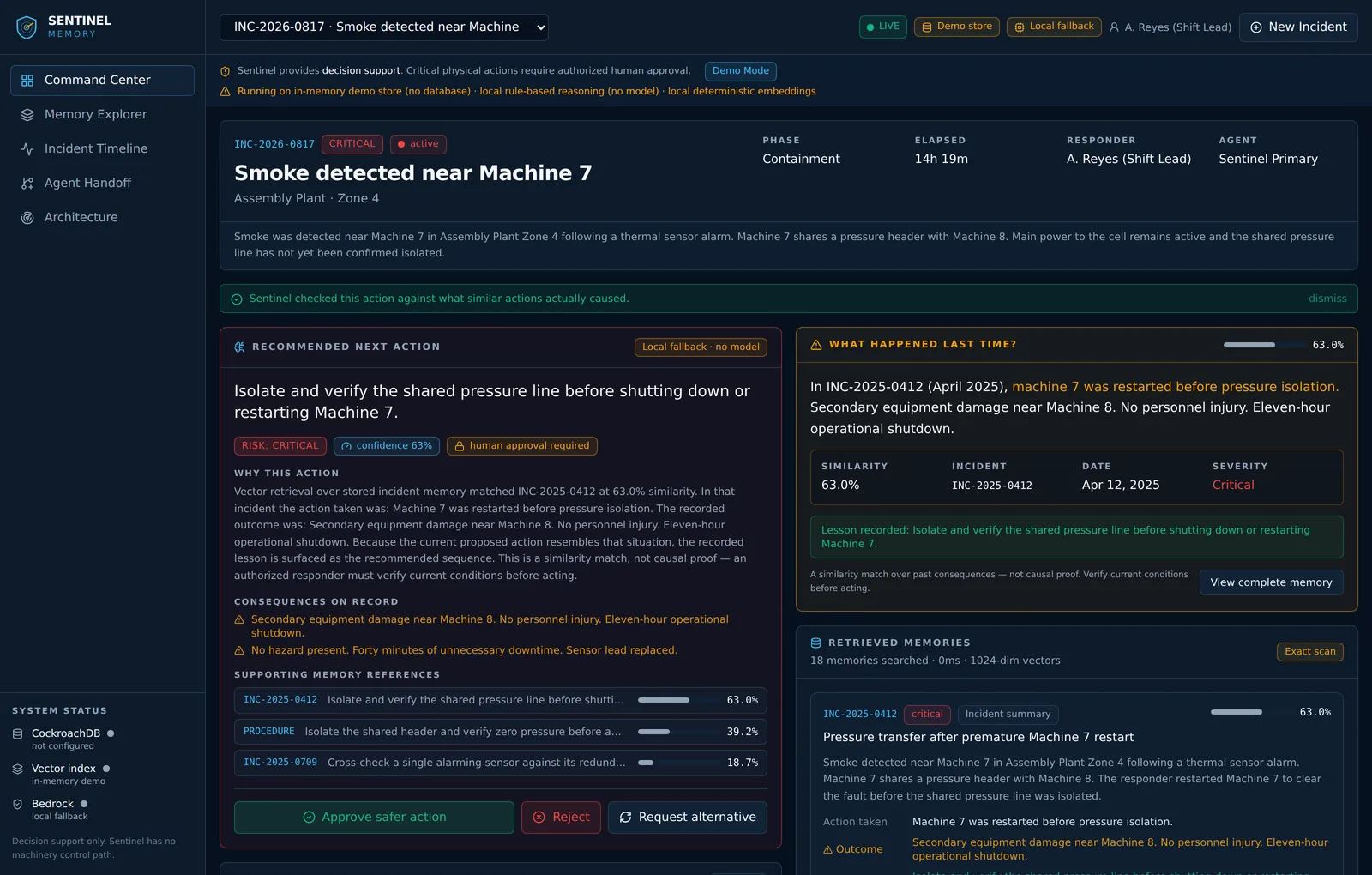
During industrial emergencies, personnel rotate and agents restart, losing the record of what was already attempted and what it caused. The same reasonable-looking action gets taken again — including the one that did damage last time — because the consequence history is not available at the moment the decision is being made. An agent whose memory is a context window reproduces that failure faster.
What it does
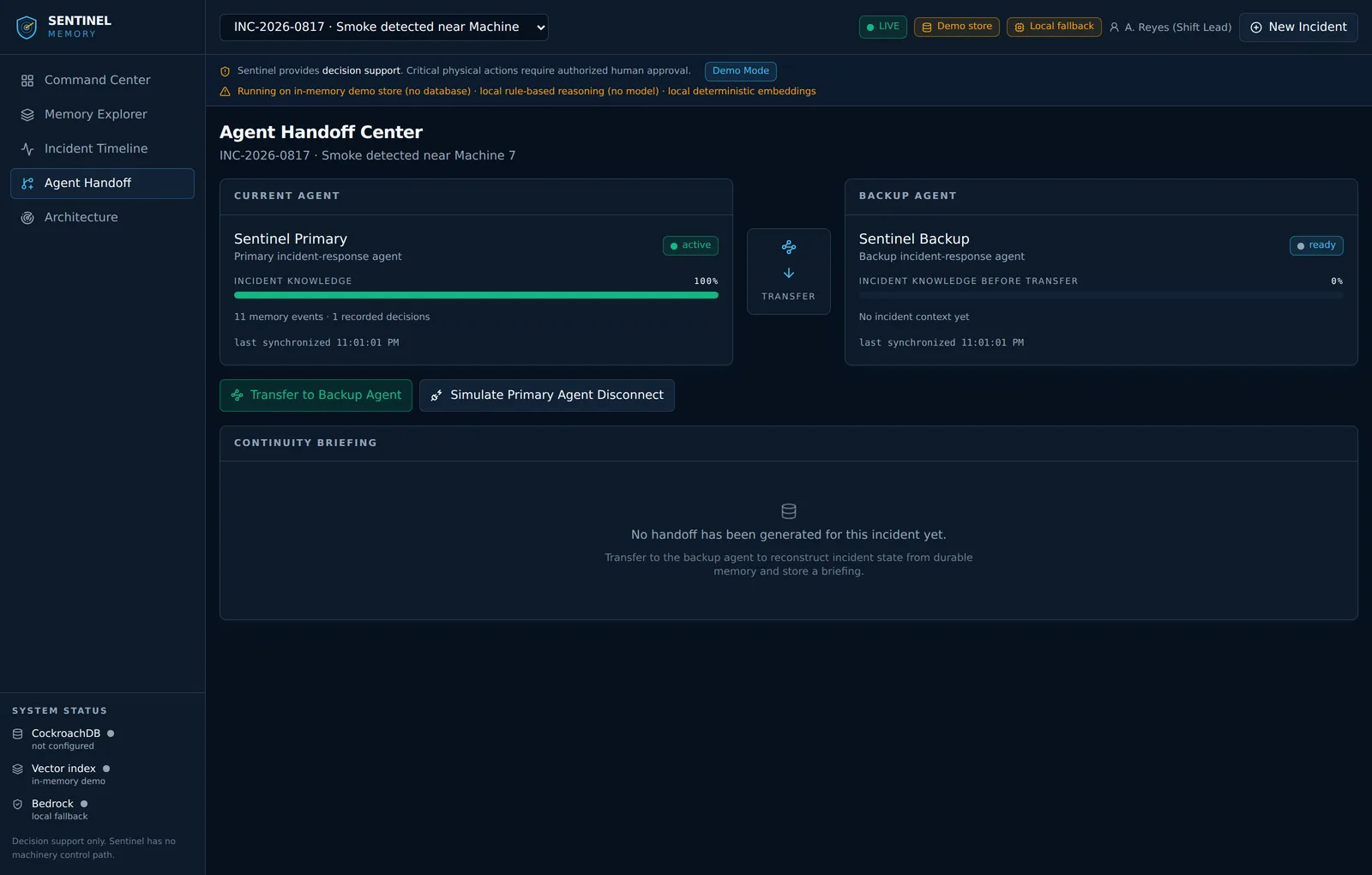
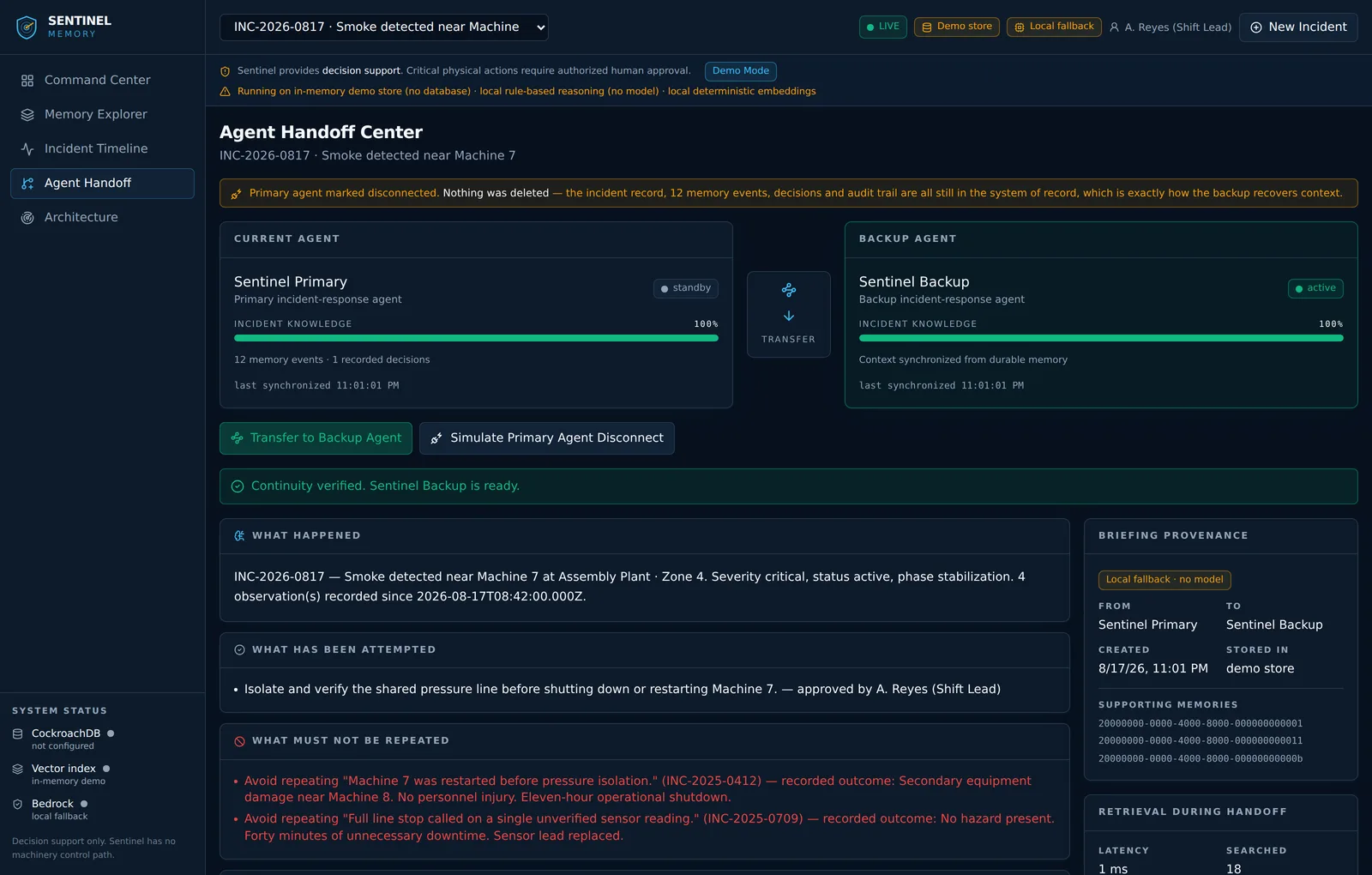
Sentinel Memory is an incident-response command centre where a database, not a context window, is the memory. When a responder proposes an action, the system embeds it, searches CockroachDB's distributed vector index for precedents, and surfaces what that exact action cost during a previous incident — with the incident code, date and damage — before recommending a safer sequence and citing the memory it drew that from. Approval commits the decision, the recommendation status, the incident state and the audit event in a single transaction. When the primary agent disconnects, a backup agent reconstructs the whole incident from the database alone.
Architecture
Next.js App Router with React 19 and TypeScript on the client; Node.js API routes holding the agent loop; CockroachDB Cloud for episodic and semantic memory with a VECTOR column and cosine-distance index; Amazon Bedrock via the Converse API for reasoning and embeddings. DataStore, EmbeddingProvider and Reasoner are interfaces with labelled local fallbacks, so the whole system is previewable and testable without credentials.
Built with
- TypeScript
- Next.js
- React 19
- Tailwind CSS
- CockroachDB Cloud
- Distributed Vector Indexing
- Amazon Bedrock
- Zod
- Vitest
- Vercel
What it taught
- Agent memory is two problems, not one. Episodic memory (what happened, in order) and semantic memory (what past actions caused) have different shapes and different consumers; conflating them yields a system that can replay a timeline or find similar text, but cannot answer "someone is about to do X — has X hurt us before?"
- Keeping both in one database is the actual advantage, and the reason is the join: retrieval returns the memory together with its incident code, severity and date in a single query, and the human decision that follows is transactional against the same rows.
- Structure memory around the action. Embedding incident summaries gets you "similar incidents"; storing action → outcome → lesson as distinct fields gets you "this specific action caused this specific damage".
- Constraints beat prompts for safety. The prompt is necessary and not sufficient — schema CHECK constraints, Zod validation and a post-model safety floor are what make the guarantee real.
- Honest degradation turned out to be a feature rather than a compliance chore: labelling exactly which implementation is running makes the architecture legible in a way a demo claiming everything works is not.
ThinkTrace AI
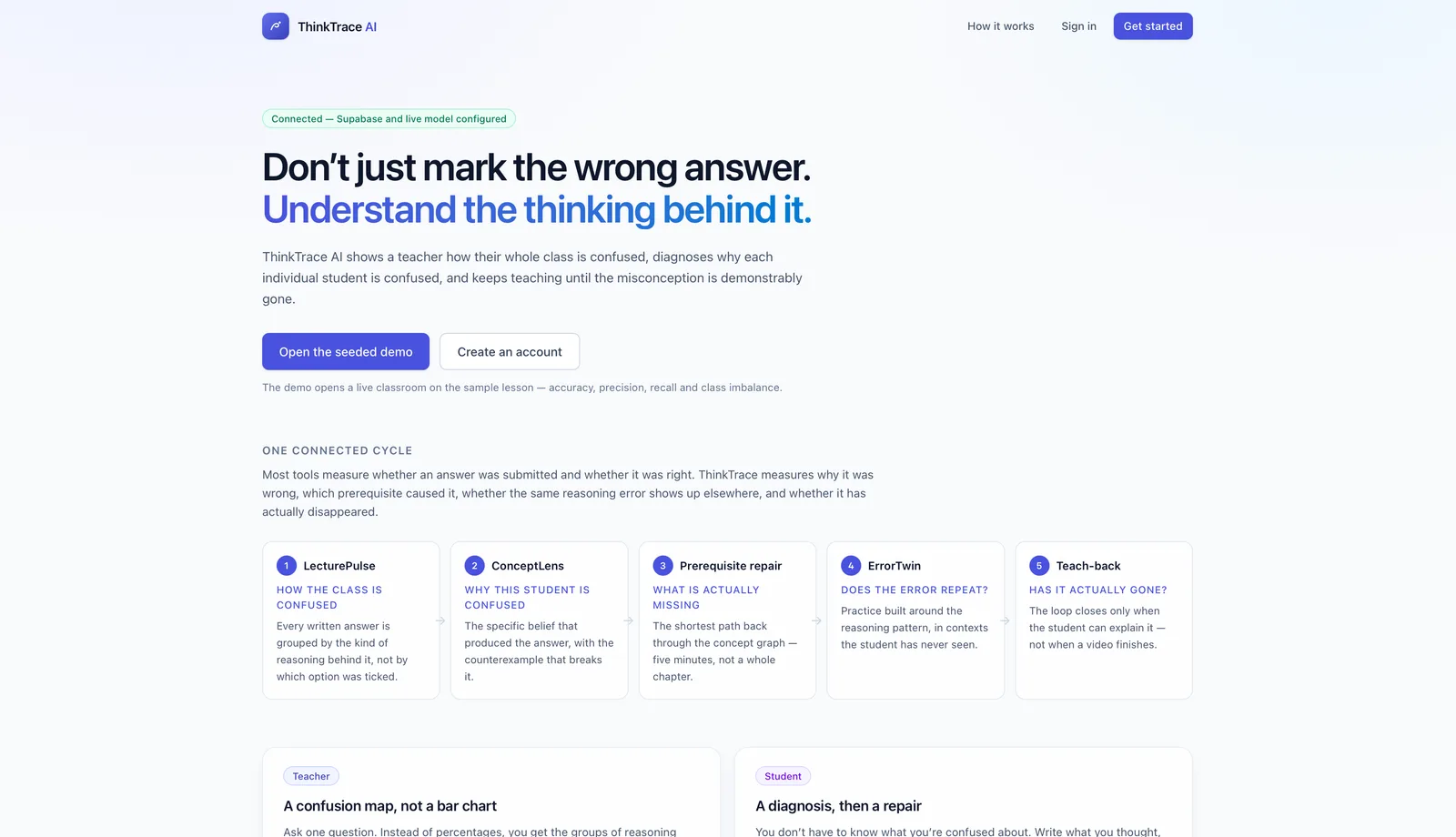
Don't just mark the wrong answer. ThinkTrace AI reads each student's written reasoning, groups the class by how it is confused, and keeps teaching until the misconception is demonstrably gone.
The problem
Marking an answer wrong records that a student failed without recording why. A teacher sees a score distribution, not the shape of the class's confusion, and a student sees a cross, not the specific belief that produced it. The two views are usually handled by separate tools — a quiz grader, a polling app, a tutor — so neither the class-level pattern nor the individual diagnosis informs the other.
What it does
ThinkTrace AI shows a teacher how their whole class is confused, diagnoses why each individual student is confused, and keeps teaching until the misconception is demonstrably gone. It runs as one connected cycle of five stages: LecturePulse groups every written answer by the kind of reasoning behind it rather than by which option was ticked; ConceptLens identifies the specific belief that produced the answer and the counterexample that breaks it; prerequisite repair finds the shortest path back through the concept graph; ErrorTwin re-tests the same reasoning pattern in contexts the student has never seen; and Teach-back closes the loop only when the student can explain the concept themselves, not when a video finishes. Where most tools measure whether an answer was submitted and whether it was right, this measures why it was wrong, which prerequisite caused it, whether the same reasoning error appears elsewhere, and whether it has actually disappeared.
Built with
- TypeScript
- Next.js
- React
- Supabase
AstraNova
An AI trading copilot for India's options traders.
The problem
Retail options traders in India work across fragmented tools — market data in one place, analysis in another, execution in a third — with no shared context carried between them.
What it does
AstraNova joins live Angel One market data, AI-scored trading signals, real broker execution and a Gemini-powered assistant into a single surface. This description is taken from the project's own repository summary; a fuller write-up is not published here because the repository is currently private.
Built with
- Python
- Google Gemini
- Angel One API
- Real-time Market Data
- Repository is private
- Live demo unverified
- Devpost submission unverified
- YouTube demo unverified
The source repository is private on GitHub. The description above comes from the project's own repository summary rather than from a public README.
LabGuard AI
An autonomous research agent that challenges a scientific claim, runs the experiments that could disprove it, repairs the runs that break, and returns an evidence-backed verdict with every check shown.
The problem
A scientific claim is easy to state and expensive to check. Verifying one means designing the experiments that could disprove it, running them, repairing the runs that fail for incidental reasons, and keeping enough of a record that someone else can see how the conclusion was reached.
What it does
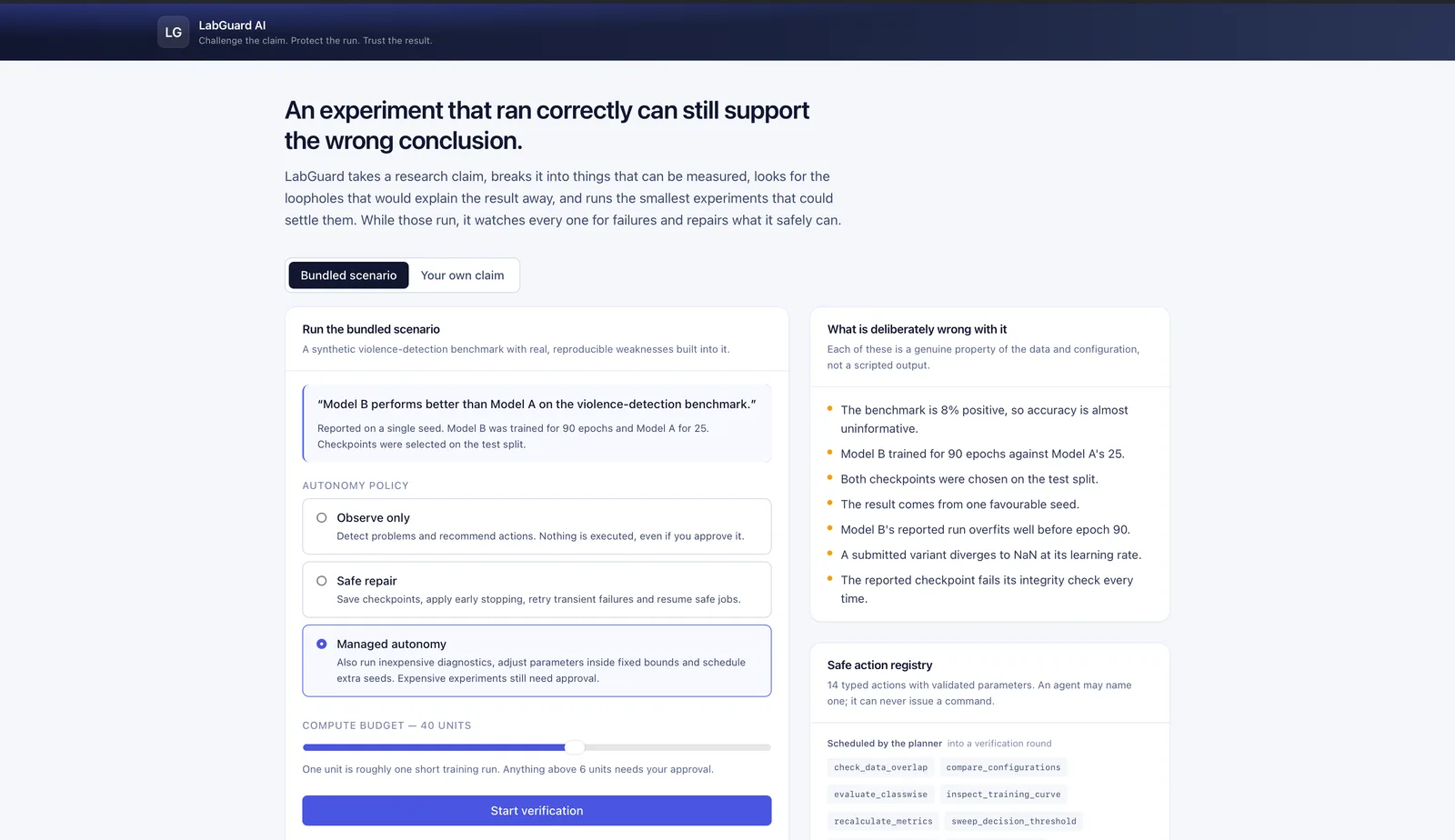
LabGuard AI takes a research claim, finds the scientific loopholes that could explain the result away, runs the smallest experiments that would settle them, watches every run for failures and repairs what it safely can, then issues an evidence-backed verdict. Two loops run over one shared state: a Scientific Skeptic loop asking whether the evidence actually supports the conclusion even when every run succeeded, and an Experiment Guardian loop asking whether each run is executing correctly and repairing what policy allows. It was built for the hackathon's Taskmaster track as a complete workflow run to completion rather than a chat interface.
Architecture
A Next.js dashboard on Cloud Run submits claims to a FastAPI service, which drives an orchestrator holding the claim state machine. Seven agents — Claim Analyst, Scientific Skeptic, Experiment Planner, Run Manager, RunMedic, Evidence Auditor and Verdict Agent — run on Gemini via the Google Agent Development Kit, sharing state through the store rather than talking to each other, so the ledger stays a complete account of the run. Approved jobs go over Pub/Sub to a Cloud Run experiment worker; state lives in Firestore and reports and curves in Cloud Storage. The model proposes and validated code disposes: the LLM agents are given a strict output schema and no tools, so a response may only name an action from a typed registry within the candidate set the planner already validated against budget. Parameters are bound-checked with pydantic twice, at planning and again in the worker before execution, and the model cannot produce a number — every metric, interval, per-class figure, health detection and reliability score is computed in Python. The safe action registry holds fourteen typed actions with validated parameters — an agent may name one, it can never issue a command — and the operator sets both an autonomy policy (observe only, safe repair, or managed autonomy, where inexpensive diagnostics and in-bounds parameter changes run without asking while expensive experiments still need approval) and a compute budget above which work requires explicit approval.
Built with
- Python
- FastAPI
- Pydantic
- NumPy
- scikit-learn
- Google Agent Development Kit
- Gemini
- TypeScript
- Next.js
- React
- Firestore
- Pub/Sub
- Cloud Run
- Cloud Storage
SplitShield
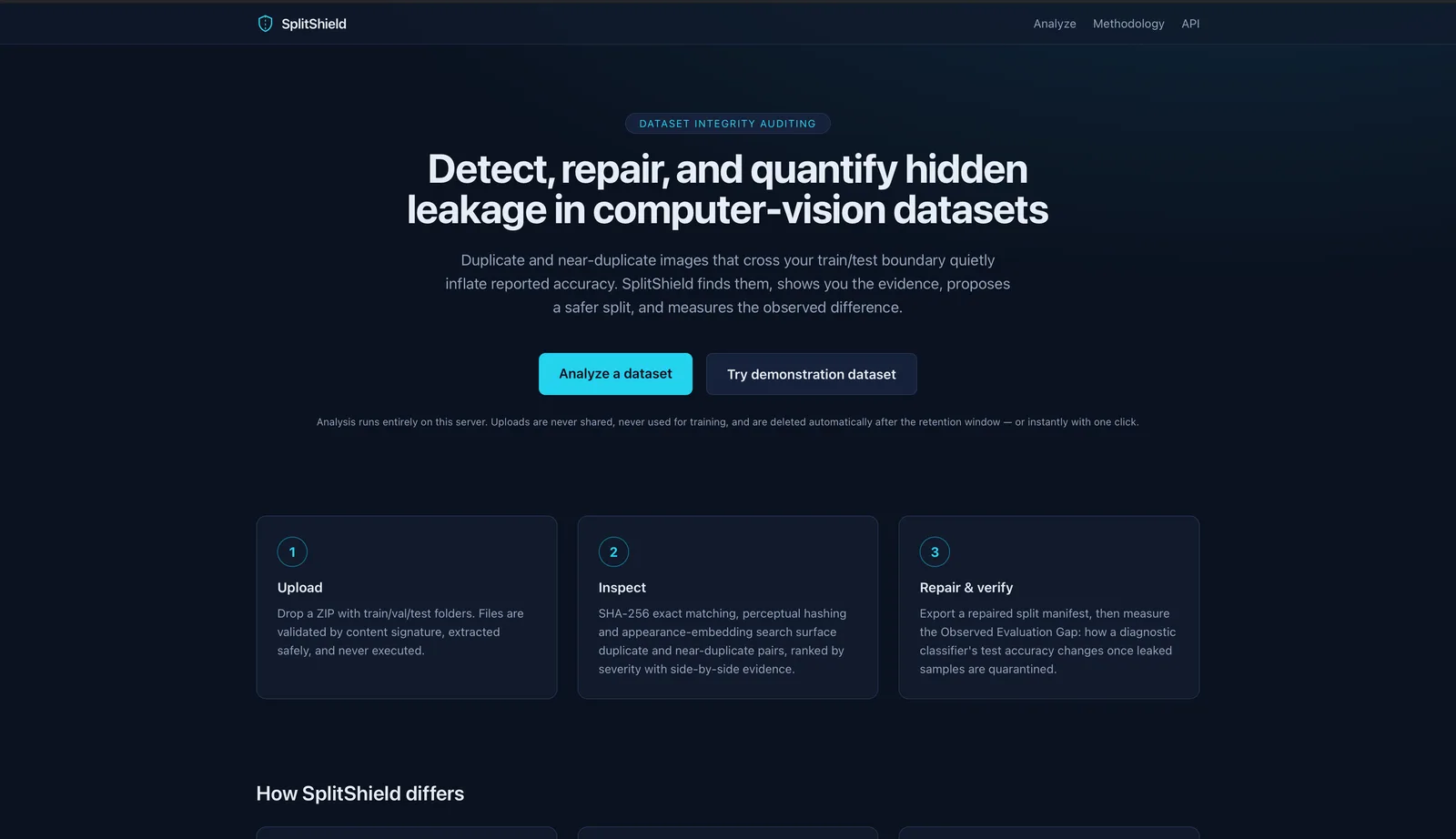
Duplicate images leaking between train and test make model accuracy look better than it is. SplitShield finds the leakage, shows the evidence, repairs the split, and measures the difference.
The problem
Duplicate and near-duplicate images that cross the train/validation/test boundary quietly inflate reported model performance: the model is graded on samples it has effectively already seen. This data leakage is common in scraped and merged datasets, hard to spot by eye, and rarely quantified.
What it does
SplitShield audits an image-classification dataset for leakage across its splits, shows the evidence behind each finding, repairs the split, and quantifies how much the reported number changes as a result. It is aimed at computer-vision researchers, students and ML engineers who need to know whether their splits are trustworthy before quoting a number. Duplicate and near-duplicate pairs are surfaced by SHA-256 exact matching, perceptual hashing and appearance-embedding search, ranked by severity with side-by-side evidence. The repair is judged by an Observed Evaluation Gap: how much a diagnostic classifier's test accuracy moves once the leaked samples are quarantined. Uploads are analysed on the server, never shared or used for training, and deleted after a retention window or immediately on request.
Architecture
A Next.js frontend talks over JSON HTTP to a FastAPI backend that runs the audit as a staged pipeline — ingest, index, exact-match, perceptual hash, embeddings, classify, score, repair, evaluation, report. Jobs run in a bounded thread pool and every stage transition is persisted to SQLite, so the UI polls rather than blocking. Storage is a local directory abstraction using random internal identifiers rather than user paths, behind an interface an S3-compatible layer can replace. Embeddings are pluggable: MobileNetV3-Small when torch and weights are available, otherwise a documented classical appearance descriptor built from structure, chromaticity and gradient histograms — and the active backend is reported in both the UI and the report rather than assumed.
Built with
- Python
- FastAPI
- SQLite
- PyTorch
- MobileNetV3-Small
- TypeScript
- Next.js
- React
- Tailwind CSS
- Recharts
- Docker